Posts

Showing posts with the label Research Editors

What to Look For In an Editor
Image
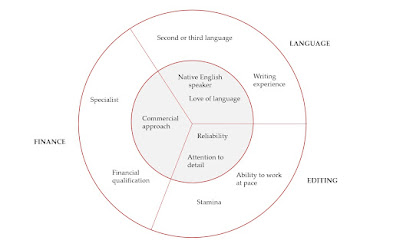
What makes a good editor? Here are some of the qualities and skills that make a good editor: Native English . Far more people in the world speak English as a second language than as a first. It is tempting therefore to think that simply having a high level of English is sufficient for an editor. However, the English language has a richness and depth that can only be fully grasped if steeped in it since infancy. This means that editors for whom English is not their native language will lack the proficiency and instinctive grasp of the language that native English speakers possess. Love of language . Natural editors have a deep appreciation and love of language. They love to read, often speak a second or third language and may have writing experience themselves. This affection manifests itself in their editing. They highly value accuracy, clarity and integrity in the written word and derive great satisfaction from improving and crafting it, drawing out the intended meaning with skill and...

My Editor Has Resigned: What Are My Options?

Image
    If your editor has resigned out of the blue, it’s only natural to feel under pressure. With competing deadlines and large volumes of research to get through, the loss of an editor can cause major problems – including scheduling gaps that need to be quickly filled. In this piece, we look at the options available to you when an editor resigns. 1) Redistribute the work Redistributing the previous editor’s workload is the quickest and lowest-cost option. You don’t need to recruit anyone new and the problem is solved quickly. If you have the resources to cope with the workload, this is the most feasible option. However, this might affect your team. Given that most reports are time-sensitive, it could increase pressure on your other editors, especially in results season. If your team is already struggling to devote enough time and attention to their own work, the quality of the output overall could suffer. 2) Hire a new editor On paper, hiring a new editor sounds like the most s...

My Editor Has Resigned What Are My Options

Image
If your editor has resigned out of the blue, it’s only natural to feel under pressure. With competing deadlines and large volumes of research to get through, the loss of an editor can cause major problems – including scheduling gaps that need to be quickly filled. In this piece, we look at the options available to you when an editor resigns. 1) Redistribute the work Redistributing the previous editor’s workload is the quickest and lowest-cost option. You don’t need to recruit anyone new and the problem is solved quickly. If you have the resources to cope with the workload, this is the most feasible option. However, this might affect your team. Given that most reports are time-sensitive, it could increase pressure on your other editors, especially in results season. If your team is already struggling to devote enough time and attention to their own work, the quality of the output overall could suffer. 2) Hire a new editor On paper, hiring a new editor sounds like the most sensible optio...

Orwell’s Seventh Rule – Focus on the Message

Image
George Orwell’s six rules for good writing are often quoted . They contain good sense advice such as “If it is possible to cut a word out, always cut it out” and “Never use a long word where a short one would do”. In investment research, which often has to appeal to diverse audiences, reminders to keep things simple and unpretentious are valuable. There is a seventh piece of advice in that same essay that is much less quoted . Orwell also said “correct grammar and syntax…are of no importance so long as one makes one’s meaning clear”. This might be blasphemy for some, but it is crucial as a reminder of what is important. A good piece of writing conveys its meaning as clearly and fluently as possible. Enforcing rules therefore is important if it helps that, but they shouldn’t necessarily be imposed for their own sake. It is crucial to remember what they are for – to provide a common framework for understanding. However, not only are they often rules of thumb that have morphed into hard a...

Finra Eases Two-year Limit For Unregistered Sas

Image
One of the biggest bugbears for SAs is the danger of losing their licence once they are out of work. From the date of being de-registered by a firm, SAs have two years to get re-registered and keep their licence active. If they don’t manage this, after the two years are up, they have to retake the Series 16 exam, but they can only do this if they can persuade a firm to take them on and sponsor them to do so. However, most firms require SAs to have an active licence in place before they will hire them. This leads to a Catch-22 situation: in order to get re-registered they have to be taken on by a firm, but in order to be taken on by a firm they have to be registered! Some firms will allow unregistered SAs to retake the exam while working and sometimes it is possible to obtain a waiver from FINRA. But neither option is certain. This has been a source of unfairness for out-of-work SAs, particularly those who have had the bad luck of losing work during a prolonged downturn. Change is comin...

Do You Know What You Don’t Know

Image
What does an editor do? Is it just run spellcheck and hit send? If only it were that simple… One of the things editors do is try to make sense of complex sentences. Often authors will come up with a sentence that makes perfect sense in their mind, but when the words hit the page the meaning is obscure to the reader. The editor’s job is to make that sentence comprehensible. The editor must therefore spend time and effort trying to parse the meaning. For example: “You don’t know what you don’t know you don’t know.” This sentence features at the end of the book The Hidden Half by Michael Blastland. Is it gobbledygook or is there some meaning in there? Let’s analyse what it means. There are three “you don’t know”s and a crucial “what” on which the whole sentence hangs. Let’s start with “You don’t know”. Will the FTSE100 go up or down tomorrow? You don’t know. There is no uncertainty in this. Hundreds of years of stockmarket movements tell us with certainty that predicting the movement of ...

FINRA gives unregistered SAs a second chance

Image
Second chance for unregistered SAs FINRA has given SAs deregistered before March 2022 a second chance to maintain their registrations. Its new Maintaining Qualifications Program (MQP) set up in 2022 enables SAs without an employer to maintain their registration for five years by carrying out continuing education through the FINRA website.   However, SAs deregistered before March 2022 had just two months between January and March 2022 to sign up to the MQP. Some SAs without registrations were unaware of the programme and so failed to get registered, thus risking losing their licence. FINRA has now opened up a second and longer enrollment period. SAs deregistered between 15 March 2020 and 15 March 2022 now have until 31 December 2023 to register with the MQP. They must have been registered continuously for the 12 months before their registration was terminated. For example, if their registration was terminated on 31 January 2022, they would have to have been registered at the latest ...

Find Your Unhappy: Adjectives As Nouns

Image
If your initial reaction to the first two sentences above is to think “Ugh”, you are in good company. They are offensive to the mind. “A new interactive what?” the brain protests.    Increasingly it seems, however, the adjective is the new noun. Things that describe things are now the things themselves. It is not a “blue something”, it’s just a “blue”. But the last sentence does not offend. What was once an adjective has become a noun, but it is accepted. Why is this? Usage leads to acceptance. Linguistic changes depend on usage to survive. Once a phrase is introduced by an innovator, someone else has to adopt it to give it life. The more widely a phrase is used, the stronger its roots in the vernacular. Over time, through constant use, the phrase becomes inoffensive. Adjectives have always become nouns; it’s just that the offensive ones above are new. Changes to language like this can happen stealthily so that we don’t notice. One example is the phrase “thrown under a bus”, ...

HODL – How a Typo Became a Rallying Cry

Image
It was 18 December 2013. Brexiters were seen as “fruitcakes and loonies” by then UK prime minister David Cameron, Trump was still just a reality TV star with a Twitter account, and one of the last bailouts of the financial crisis had just taken place with the EU handing over EUR10bn to Cyprus. Over in the nascent cryptocurrency world, the price of Bitcoin had dropped from an all-time high of $1,100 to $420, a fall of 62%. This was causing waves in the Bitcoin community.    On the bitcointalk.org message board, a poster called “GameKyuubi” had a little rant about what a terrible trader he was and how the best thing to do was hold through the considerable bear markets Bitcoin experienced. But he’d been drinking, so instead of typing “Hold” he typed “Hodl” in all caps in the subject line: “I AM HODLING” Explaining his logic he said “You only sell in a bear market if you are a good day trader or an illusioned [sic] noob. The people in between hold. In a zero-sum game such as this,...

Inflation Hits Gas, Oil, Timber and…Words

Image
It is not just commodities such as oil and timber that are subject to inflation. Words are too. Inflation is when the purchasing power of the money we hold falls so with a given amount of currency we can buy less. Words in one sense are like money. Their value fluctuates and the amount of meaning we can ‘buy’ with them rises or falls.   For example, the word “awesome” started life in the 1500s meaning “inspiring awe or dread”. By the 1960s it had a much weaker, colloquial sense of just “very good”. Now in order to express the original meaning, we have to use several words, where just one was sufficient before. This type of semantic shift is known as broadening. Another example is the word “hierarchy”, which used to mean a host of angels, but now means a group of people or things organised into ranks. There is also broadening’s opposite, narrowing, where a word’s meaning becomes more precise, thus strengthens. For example, “meat” used to mean food of any type. This inflation and def...